SDQとは?
SDQ(Strength and Difficulties Questionnaire:子どもの強さと困難さアンケート)は、子どもの情緒や行動についての25の質問項目を親または学校教師が回答する形式の短いアンケートです。子どものメンタルヘルス全般をカバーするスクリーニング尺度として、ロバート・グッドマン博士によって英国で開発され1)、信頼性と妥当性の検証が積み重ねられ、今では世界各国で臨床評価、学校健診などのスクリーニング、そしてさまざまな研究の目的で広く用いられています。
1)Goodman R: The strength and difficulties questionnaire: a research note. Japanese Child Psychol Psychiatry 1997, 38:581–586.
SDQ(Strength and Difficulties Questionnaire)(英語サイト)
SDQ日本語版
以下の日本語訳は原著者に承諾されたものです。原著者らが運営するサイト(youthinmind)に掲載されています(sdqinfo.org)。
子どもの強さと困難さアンケート
子どもの強さと困難さアンケート(表面)+追加項目(裏面)
著作権についての留意点: sdqinfo.org より抜粋
SDQは、英語でも翻訳でも、パブリックドメインではない著作権文書です。そのため、いかなる方法でも(例:質問の文言の変更、質問の追加、または一部のみの実施など)変更することはできません。 これは、SDQ が研究間や機関間で完全に比較可能であることを保証するためです。同じように 高品質と一貫性を担保するため、無許可の翻訳は許可されていません。個人または非営利団体は無料でダウンロードして紙にコピーすることができます(ただし、家族に料金を請求しない限り)。
ユーザーは、youthinmindの事前の許可なく、いかなる目的においても電子版を作成または配布することはできません。翻訳や電子版作成にご興味がある場合は、必ず事前に support@youthinmind.com までご連絡ください。
COPYRIGHT NOTICE: sdqinfo.org より抜粋
Please note that Strengths and Difficulties Questionnaires, whether in English or in translation, are copyright documents that are not in the public domain. As such, they may not be modified in any way (e.g. changing the wording of questions, adding questions or administering only subsets of questions). This is to ensure that the SDQ is fully comparable across studies and settings. Similarly, to ensure high quality and consistency, unauthorized translations are not permitted. Paper versions may be downloaded and subsequently photocopied without charge by individuals or non-profit organizations provided they are not making any charge to families.
Users are not permitted to create or distribute electronic versions for any purpose without prior authorization from youthinmind. If you are interested in making translations or creating electronic versions you MUST first contact support@youthinmind.com.
項目内容
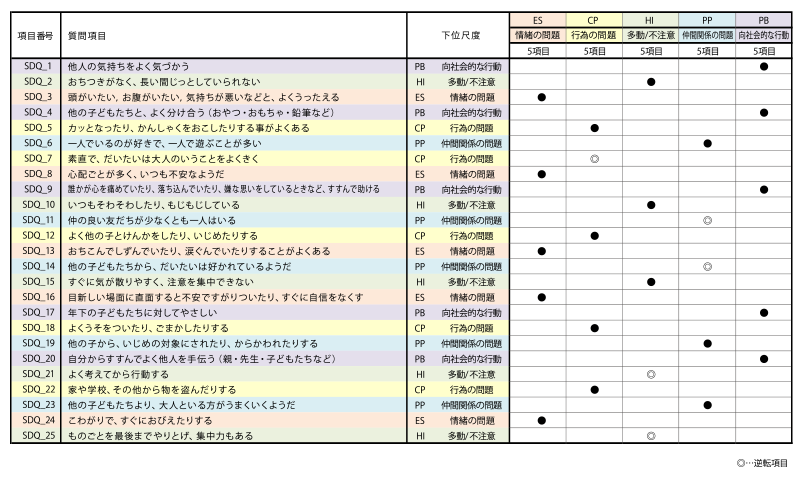
困難さに関する下位尺度は4つ、強みに関する下位尺度は一つです。
それぞれ5項目、計25項目の質問から構成されています。
困難さ(difficulties):情緒の問題、行為の問題、多動/不注意、仲間関係の問題、の4下位尺度20項目
強み(strengths):向社会的な行動、の1下位尺度5項目
表1 SDQの下位尺度
| 情緒の問題 (Emotional Symptoms:ES) |
#3,#8,#13,#16,#24 |
| 行為の問題 (Conduct Problems:CP) |
#5,#7(逆転項目),#12,#18,#22 |
| 多動/不注意 (Hyperactivity/Inattention:HI) |
#2,#10,#15,#21(逆転項目),#25(逆転項目) |
| 仲間関係の問題 (Peer Problems:PP) |
#6,#11(逆転項目),#14(逆転項目),#19,#23 |
| 向社会的な行動 (Prosocial Behavior:PB) |
#1,#4,#9,#17,#20 |
| 総合的困難さ (TDS: total difficulties score) |
合計(PBを除く4つの下位尺度の合計得点) |
|---|
得点化
各項目について、「あてはまらない」なら0点、「まああてはまる」なら1点、「あてはまる」なら2点と、3件法で評定します。各下位尺度の合計点は 0-10点となります。得点が高いほど困難さが大きいことを意味します。困難さに関する4つの下位尺度(情緒の問題、行為の問題、多動/不注意、仲間関係の問題)の合計点は、「総合的困難さ(TDS: total difficulties score)」(0-40点)として計算します。下位尺度毎に得点化する他、全体の傾向を把握する指標として、このTDSを用いることが多いです。向社会的な行動の下位尺度得点は高いほど強みが大きいことを意味します。
計算方法はHPに示されています。→http://www.sdqinfo.com/py/sdqinfo/c0.py